
4 Charts Every CMO Should See About AI, According to Consumers
March 2026
Let’s start here:
In recent days, there have been helpful new studies about patients hiding their use of AI to help them diagnose conditions before seeing doctors, as well as how consumer adoption of AI is rising as positive perception of its use by companies is falling. As the research around AI piles up, there seems to be a gap emerging related to consumer perception around AI and its use (or expected use) by retail brands specifically.
To help fill that gap in understanding, Quick Study recently surveyed 250 consumers across the US to see how much they are thinking about AI, but more specifically what their expectations are when they find out the retail brands they love are using it. Our survey revealed a deeper pattern that shows consumers don’t yet have a clear moral framework for AI. As you’ll see in the data, consumers react strongly when known values are violated by AI such as the replacement of jobs or its potential to be used to create deceptive content, but they are otherwise having a hard time defining where AI should and shouldn’t be utilized by brands they patronize.
We also found that consumers are paying attention to how brands are using AI. Despite the fact that their personal opinions of AI are not settled, consumers are still using a brand’s use (or perceived use) of AI as a point of consideration in relation to the brand’s authenticity, value, pricing, and more.
Together, these findings indicate that this is an important moment where brandsstill have the opportunity to influence consumer perception around their use of AI.
Here are 4 key learnings from our new research:


Consumers are paying attention to AI, but still forming their opinions on it

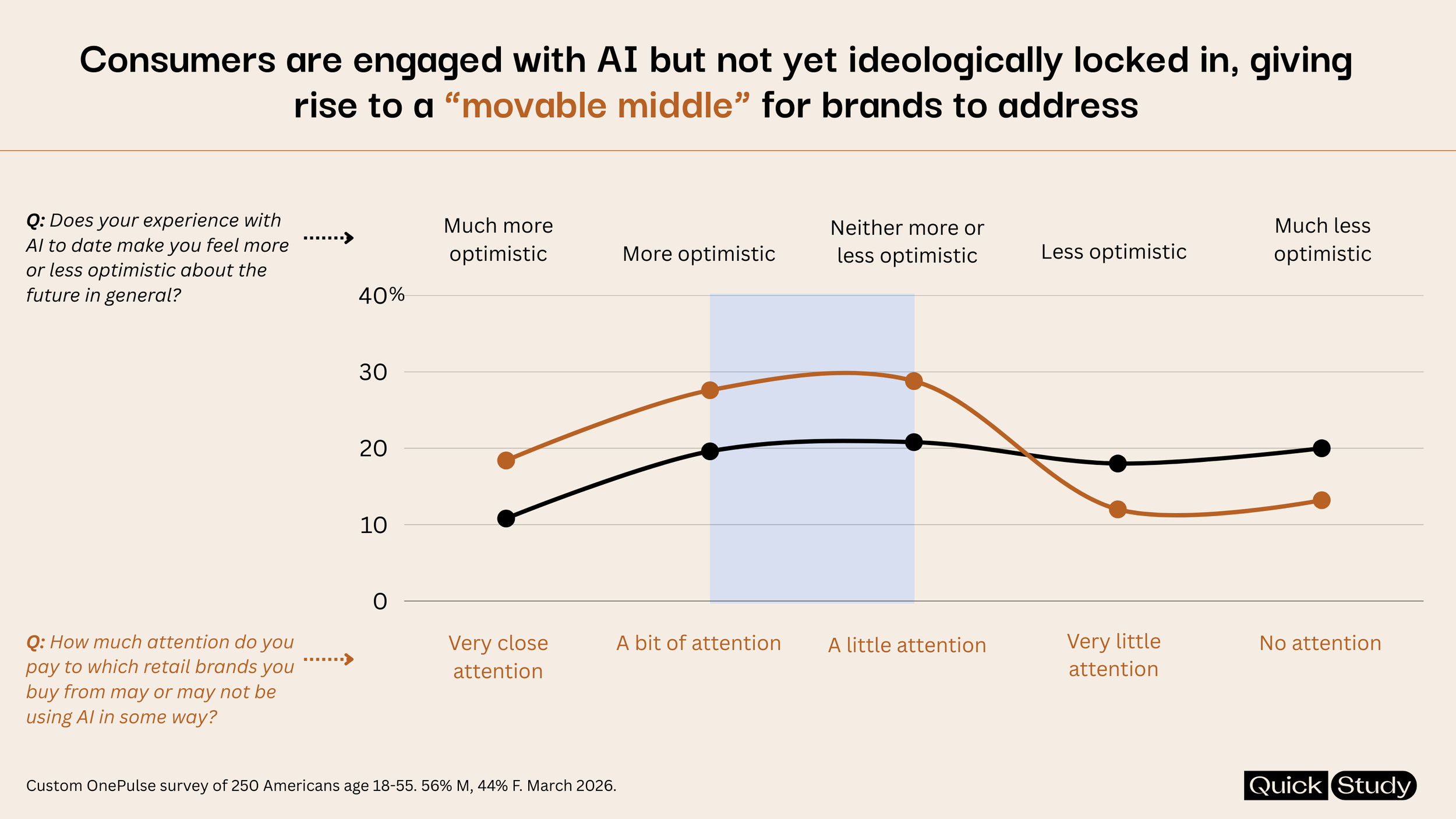
Of note: 61% of Americans are thinking about AI and its implications on the future at least weekly, and 75% are paying at least a little attention to which brands they buy from are using AI. On the flip side, there are still almost 4 in 10 Americans who think about AI and its implications on the future less than weekly or not at all. That’s a large disengaged audience that hasn’t been inundated with the headlines around AI as much as people might expect.
As a result of these mixed levels of engagement with AI, the sentiment toward AI and the willingness to include a brand’s use of AI in one’s considerations of the brand are both still malleable. The weakest positions held by Americans were usually the most extreme, indicating that the majority of consumer perceptions have not yet hardened.
2. Brands that are silent about their use of AI risk consumers creating their own assumptions
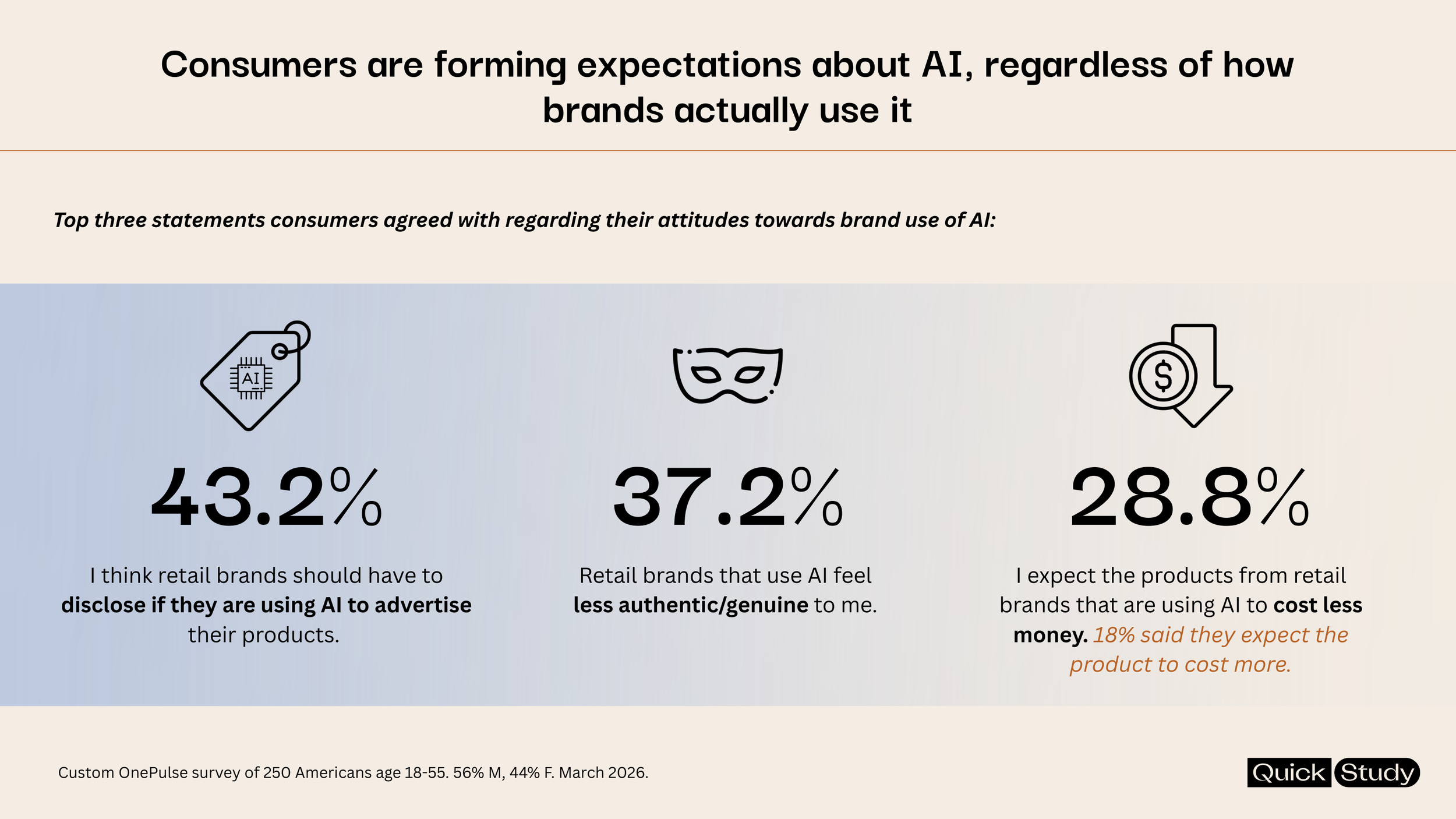
With so much conversation around AI happening, there are perceptions forming around AI and its use by brands that may not be true, but are potentially harmful nonetheless:
AI in marketing. We found that 43% of consumers think retail brands should be disclosing if AI is used specifically in their advertising. 31% said that a brand using AI to generate its marketing would make them less likely to buy from that brand.
AI vs Authenticity. 37% said brands that AI use of any kind feel less authentic/genuine.
AI’s impact on pricing. 29% of consumers surveyed think products that come from a retail brand that uses AI should cost less.
In these results, we clearly see that even though their opinion on AI is not fully formed, consumers are making assertions about what AI means to them and the brands they buy from.
3. Consumers don’t want brands replacing humans with AI
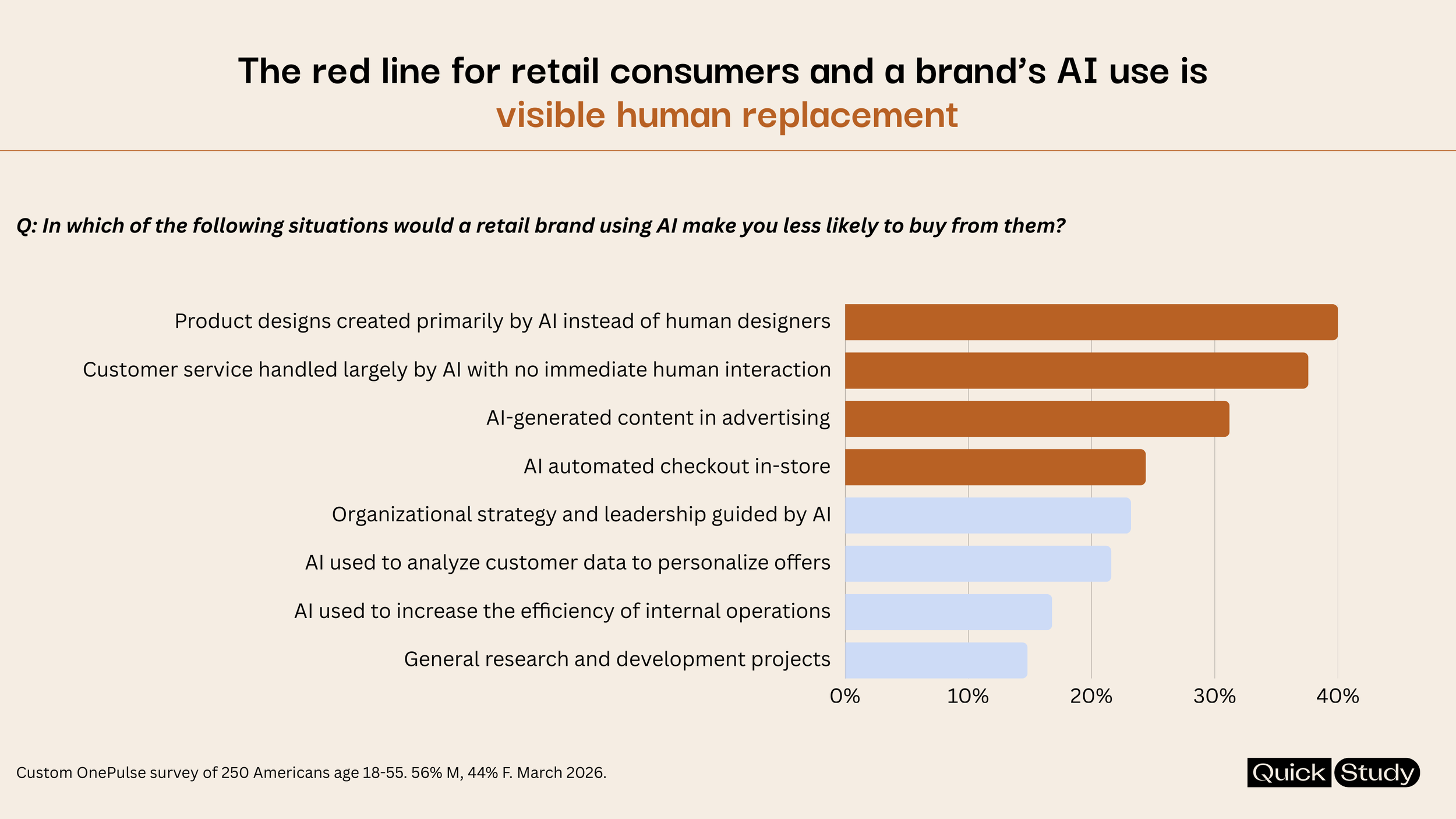
The biggest red flag for consumers is when they see humans replaced by AI. Consumers are not concerned when AI is used for decisions, research, or processes that consumers don’t directly see the impact of. But when use of AI changes the humanity of the experience – such as at the checkout counter or customer service line, in advertising, or in the act of product design/creation – AI becomes a liability for the brand and lowers the likelihood of purchase.
Some of what consumers told us:
“If [AI] takes jobs away; I am against it”
“I would be disappointed if a company was using AI to replace the work of human beings.”
“If [AI-generated content] is cheap and tacky; then yeah I lose respect for the brand. Like bad obvious copywriting; bad designs; etc.”
“If the AI use was stealing from artists or other people’s work or their artistic integrity I would not support [that brand].”
4. Brands need to justify their use of AI
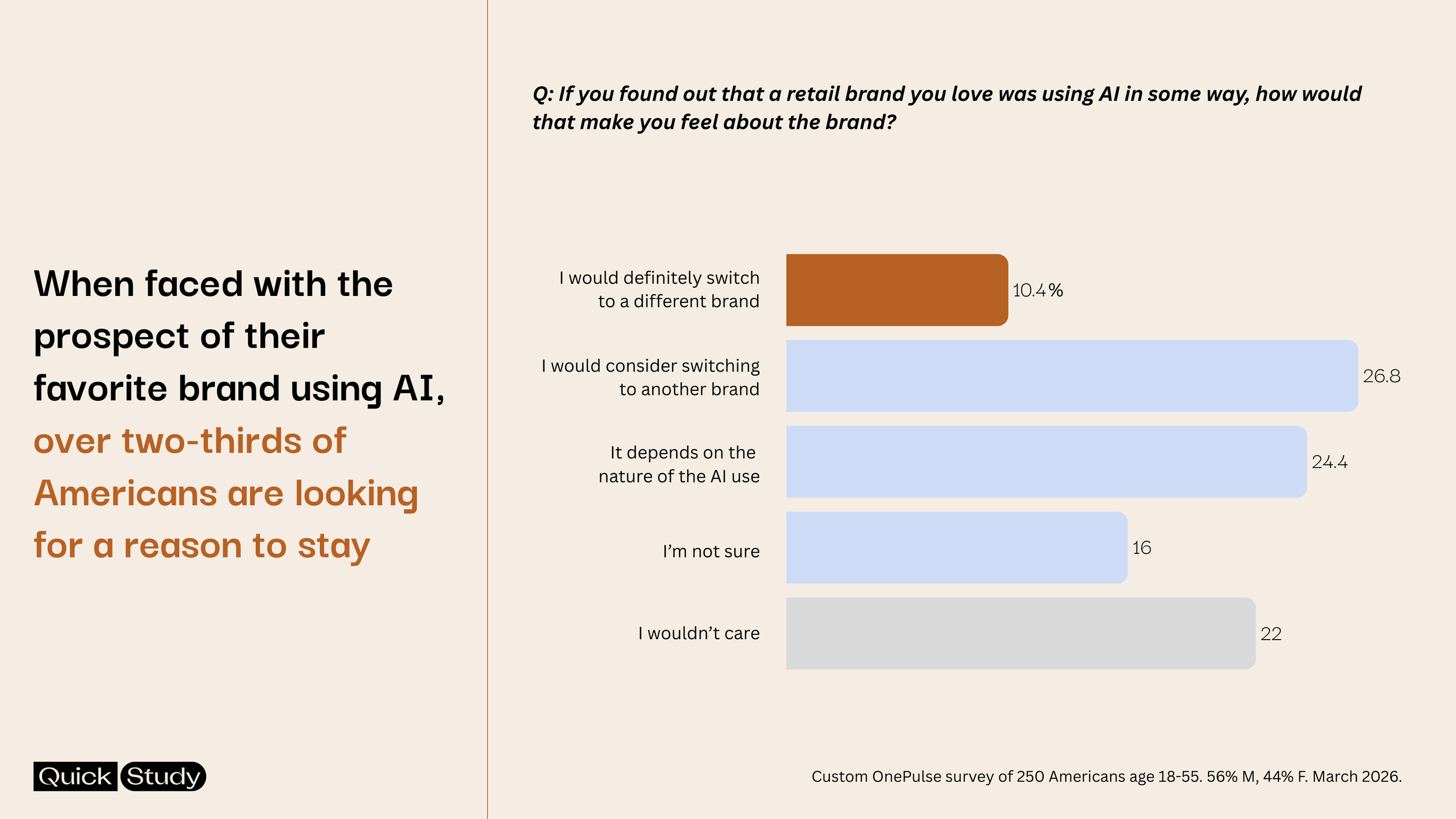
There remains ample opportunity for brands to show consumers how the use of AI can be positive, not negative. The lack of moral or values framework is truly on display in this question, where the majority of consumers aren’t sure, want to know more about the way AI is being used, or are only willing to commit to “considering” a brand change. The majority of Americans are looking for more guidance and information, which a brand using AI can provide in a way that helps alleviate fear and potential blowback.
AI is quickly becoming another test of brand values.
Consumers are still deciding where they stand, but they’re already paying attention to how brands are using it. The companies that approach AI thoughtfully, and explain their choices clearly, will have the opportunity to shape how consumers interpret it.
If you're curious how your own customers or growth audiences are thinking about AI, Quick Study regularly runs custom research studies to help brands stay ahead of the shifts shaping culture today and tomorrow.
Global CEOs say Quick Study “moves at light speed without compromising on research and quality” and that we are “the real deal—the kind of team you want in your corner for all the big, gnarly, complex ‘how are we ever going to solve this?’ problems.” If your brand needs some smart problem solving, commission Quick Study to make a Study Guide for you.
Send us an email & we’ll custom design a plan that gets you the answers you need: hello@quick.study