
Effort signaling, human washing, and the new era of brand relatability
July 2026
“Every advertisement is part of the long-term investment in the personality of the brand.”
- David Ogilvy, 1955
Let’s start here:
It’s an insane understatement to say that a lot has happened in advertising in the 71 years since David Ogilvy said those words. Approaches like Ogilvy’s helped popularize the concept of brand personas, tones of voice, and brand archetype workshops, tools meant to help sharpen and align on who a brand is and how it expresses itself in the world. The outputs of these tools were helpful for internal use, providing clarity to teams as advertising formats expanded and deliverables increased.
A changing media & consumption environment, namely due to social media, forced a major shift in this thinking over the last 15 years as brands traded long-term investments in brand personality for short-term investments in brand virality. Sometimes characterized as the “shots on goal” era of content creation, brands are fighting algorithms and an unprecedented volume of noise by doing just about everything they can to spark the smallest amount of recognition.
On top of that, being the person or team creating the viral content for a brand is also now its own sort of fame, shifting roles like social media manager from behind-the-scenes to front-facing camera and making stars of the personalities behind the brand personality. In some instances, the personalities have become intertwined, and in others, brands have found themselves embracing voices that don’t match their own but bring them awareness and fame nonetheless.
As a result of these shifts, previously unique brand personalities have flattened into self-referential Gen Z and Millennial internet code. It’s not uncommon to see dozens of brands show up in TikTok or Instagram comments making completely interchangeable jokes. The pursuit of relevance has slowly produced the opposite: brands that increasingly sound alike.
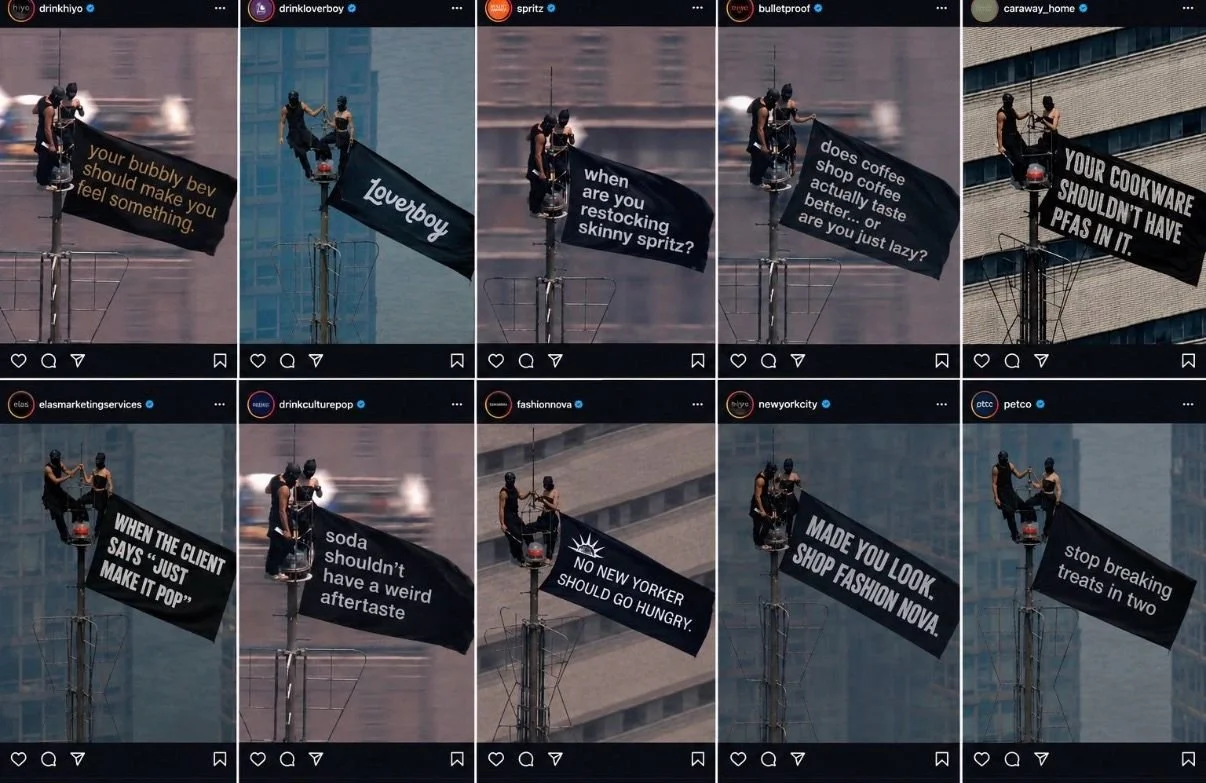
The social media era of brand personality is best exemplified by slop like this.
While flattened personalities might have been survivable on their own, AI has changed the stakes by making consumers question whether the voice they’re hearing belongs to a person at all. Almost two-thirds (63%) of Americans in a recent Pew Research poll said they think AI is moving too quickly. reddit Head of Foresight Matt Klein found that more than half (61%) of Americans come across content they can’t tell is AI or not multiple times a week. This confusion is fueling uncertainty of all kinds, especially because AI is evolving faster than the average person is comfortable with.
This uncertainty is a breeding ground for mistrust in brands. We learned in our last Study Guide that consumers are watching for brand AI use: 75% of US consumers are paying at least a little attention to which brands they buy from use AI, and 43% think retail brands should have to disclose if they are using AI to advertise their products.

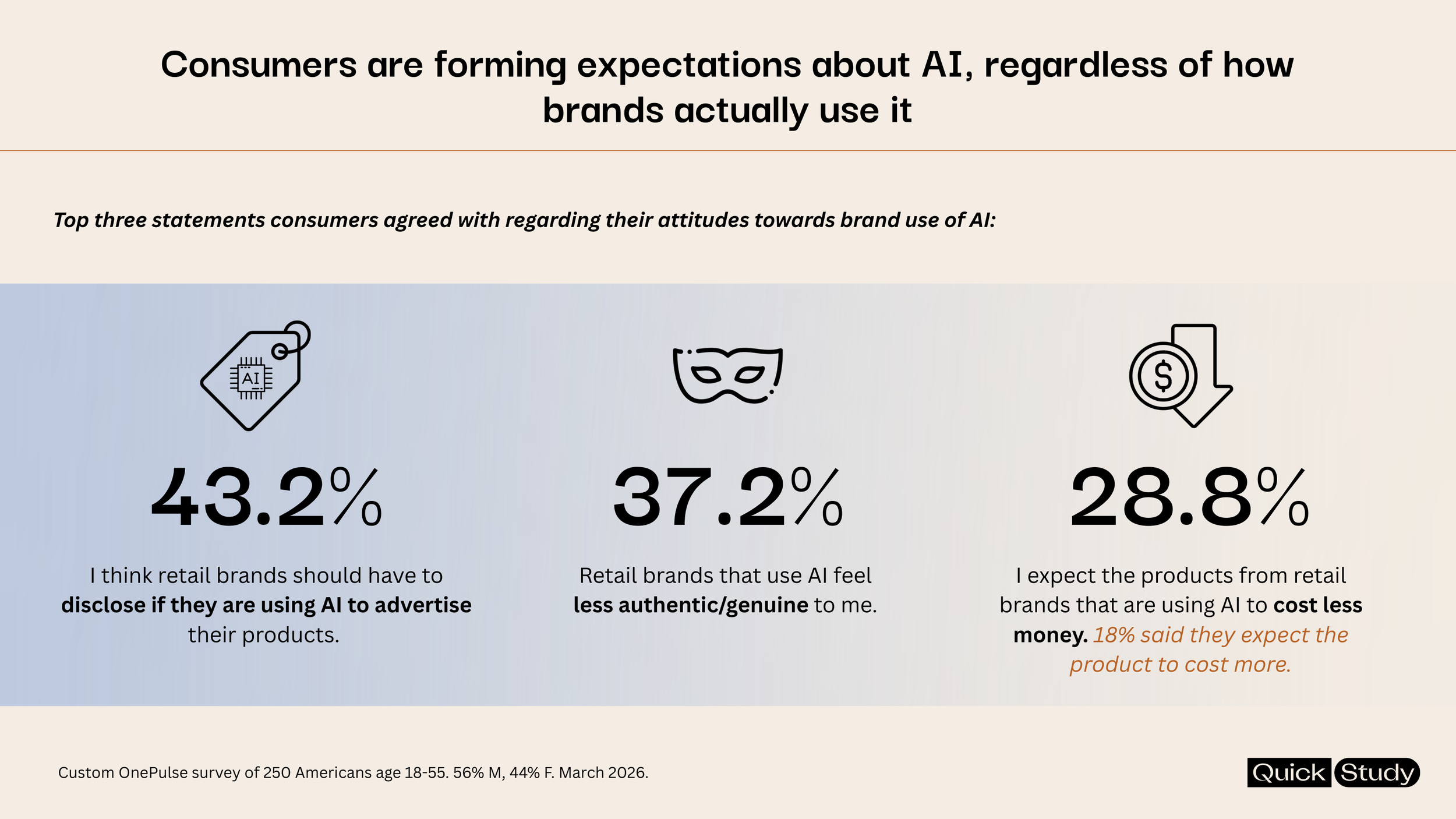
We also saw that the knowledge of a brand’s AI use shifts consumer perceptions of that brand: 29% of consumers surveyed think products that come from a retail brand that uses AI should cost less, and 37% of Americans think retail brands that use AI are less authentic/genuine, regardless of how the brand is using AI.
The challenge is that consumers are already making judgments about AI even when they aren’t sure they’re seeing it. If 61% of Americans regularly encounter content they can’t distinguish from AI, then brands don’t control when or whether those assumptions are made; they only inherit the consequences. This marks the beginning of a new chapter for brand personality, one that will require a bigger shift in how brands tell their story than there has been in decades.
Brands now need to decide which new path to relatability they will take, navigating those changes at the same time that consumers continue to change their feelings on AI. Should brands embrace AI and be public about its use in advertising? Should they use it sparingly but not speak of it? Should they publicly condemn the use of AI in advertising and take a stand?
We’re seeing all of the possible answers tried in real-time: Coca-Cola using AI for back-to-back holiday campaigns and promoting its AI experimentation as a positive, sports teams called out for lazily using AI and being seen as less real/authentic because of it, and Aerie promising no AI in its content, just to name a few.
The approach that has perhaps been the most successful thus far has been for brands to put humans front and center. Labeled both human-washing and effort signaling, brands are increasingly sharing not just what they made, but how they made it or who made it, posting extensive BTS footage (behind the scenes, not the music group) or deep dives into the people behind the product. In November, Apple TV got lots of press for shooting its new branding with practical effects. Then, a few months later, the brand launched a new Instagram account that shares predominantly human stories. The bio? “Our stories, and yours.”
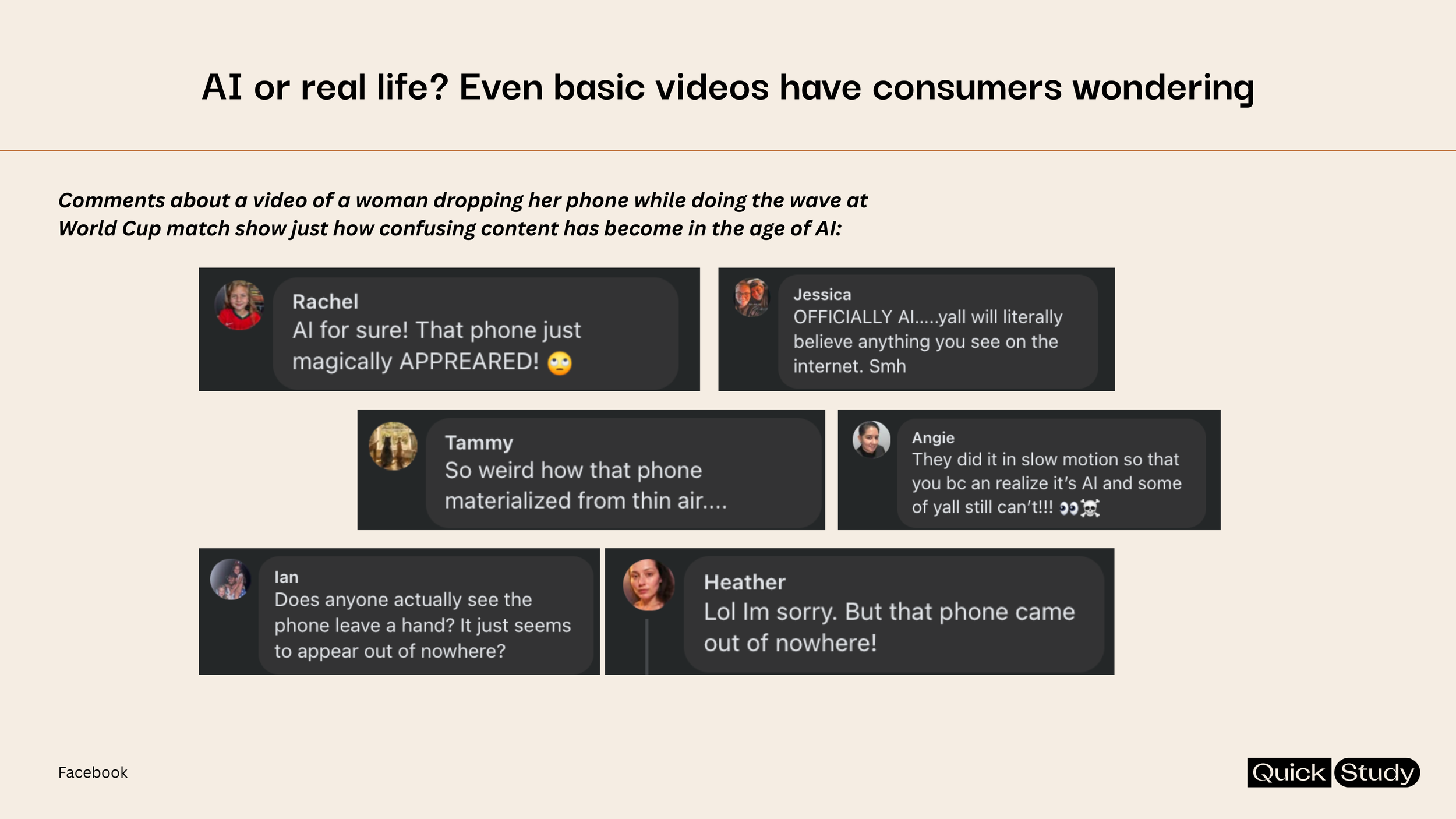
But effort signaling alone won’t solve all consumer AI confusion. In April, Quip launched an ad that consumers were convinced was AI. Even after posting a BTS video and a blog post to show their practical efforts, some consumers were still unconvinced. When video of a fan’s phone falling out of the stands was posted during the World Cup, many commenters accused the entire incident of being AI. These examples show how quickly the AI conversation has become an outlet for all kinds of confusion, and how unavoidable the topic is for basically any brand active online today.
For decades, personality was enough to make a brand feel human. Today, consumers increasingly want evidence. It’s the dawn of a new era of relatability, and brands need a distinctive and believable response.
Global CEOs say Quick Study “moves at light speed without compromising on research and quality” and that we are “the real deal—the kind of team you want in your corner for all the big, gnarly, complex ‘how are we ever going to solve this?’ problems.” If your brand needs some smart problem solving, commission Quick Study to make a Study Guide for you.
Send us an email & we’ll custom design a plan that gets you the answers you need: hello@quick.study