
Consumers are more optimistic about a future with AI. They’re less forgiving of brands that use it.
November 2026
Let’s start here:
In March, Quick Study surveyed 250 American consumers and found they were paying attention to how brands use AI, but hadn’t yet decided what to do about it. Brands, we said, still had time to set the terms.
In the eight months since, AI has become a boardroom, ballot-box and kitchen-table issue. Its use is far more commonplace, data centers became a major election issue, and Nvidia’s CEO sent markets on a roller coaster. So last week, we asked 500 Americans ages 18–55 the exact same questions.1
Our takeaway: Americans are shifting from pessimistic to optimistic about a future with AI, but cooling on the brands that use it. Most AI research measures how Americans feel about the technology itself. We measured how AI affects their relationships with the brands they buy from. And the window brands had in March has narrowed: 1 in 3 Americans have now either left a brand over its AI use or say they definitely would (33%, up from 21%).

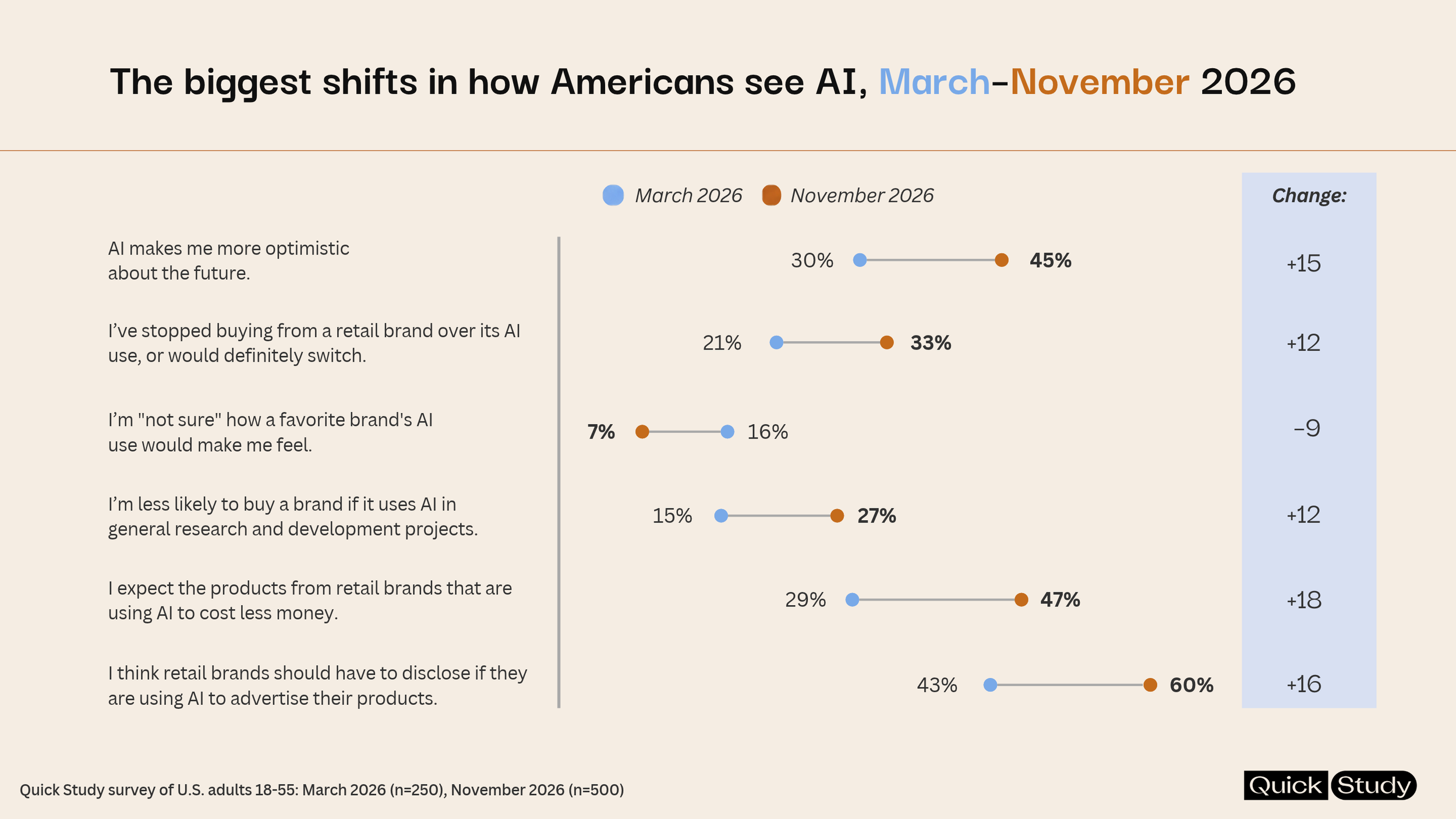
Here are the five key takeaways from the survey and what has changed since March:


Optimism around AI has increased significantly, but the same can’t be said for the acceptance of brands that use it.
Almost half of Americans now say AI makes them more optimistic about the future (45%), up 15 points since March. But that optimism stops short of the brands they buy from: 24% say they’ve already stopped buying a brand over its AI use, and 21% would definitely switch if a favorite brand used AI. And objections are piling up: 28% now object to four or more brand uses of AI, up from 16%.
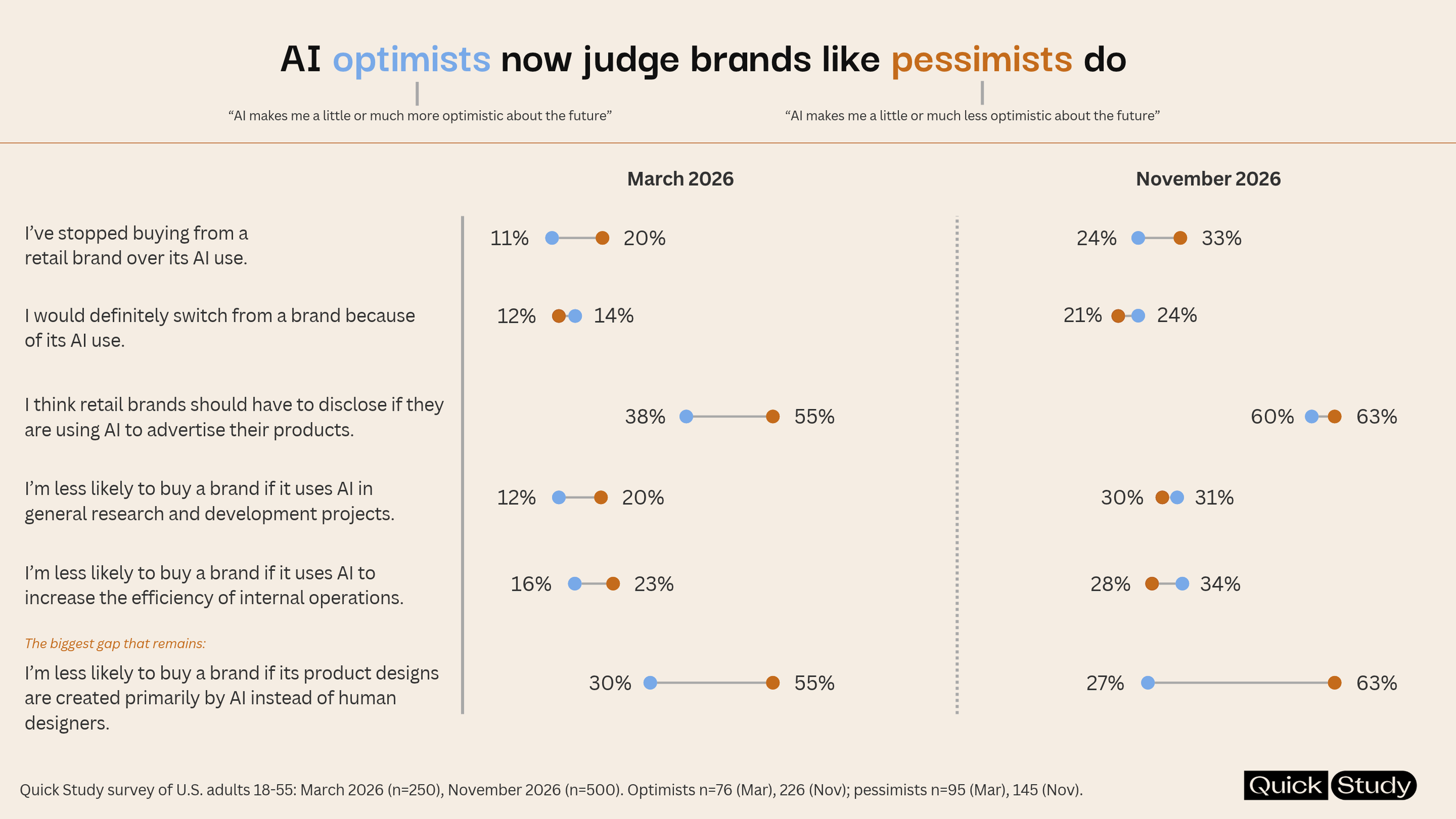
The biggest shift came from the optimists themselves. In March, AI optimists were far more relaxed about how brands used AI. Today, they’re just as likely as AI pessimists to demand disclosure, object to AI behind the scenes, and say they’d drop a favorite brand over it. Nearly 1 in 4 have already walked away from one, up from about 1 in 10 in March.

Young people are the fastest to move on from a brand because of its AI use. 34% of 18–29-year-olds have stopped buying a brand over its AI use, up sharply since March, even though they’re no more likely to think about AI than they were then. Milltown Partners found the same pattern: 31% of Gen Z in the U.S. and U.K. have stopped using a product because of its use of AI, even as 46% use AI daily.
That isn’t a contradiction; it’s the point. Consumers, and Gen Z most of all, aren’t rejecting AI. They’re separating the AI they choose to use from the AI brands use on them. As one respondent put it: “AI assistants are fine. AI-generated content is not.” Feeling good about AI personally doesn’t make someone more forgiving of how your brand uses it.
Fewer Americans are undecided about brand use of AI, and they’re moving toward both extremes.
75% of Americans now think about AI’s implications at least weekly, and 46% daily (up 14 and 21 points). That tracks with AI’s growing presence: it was mentioned in two-thirds of S&P 500 earnings calls in Q2 2026, nearly double the five-year average. Flip past any news channel or scroll on social media and you will quickly hit a story, post, or comment that invokes AI.
As that attention has grown, the undecideds have shrunk. The share who say they’re “not sure” how they’d feel if a favorite brand used AI fell from 16% to 7%. In March, nearly 3 in 10 respondents gave at least one noncommittal answer at some point in our survey. Today, it’s fewer than 1 in 5.
Those who stepped off the fence didn’t all land on the same side. The share holding a firm position on a favorite brand’s AI use, either “I’d definitely switch” or “I wouldn’t care,” grew from 32% to 44%.
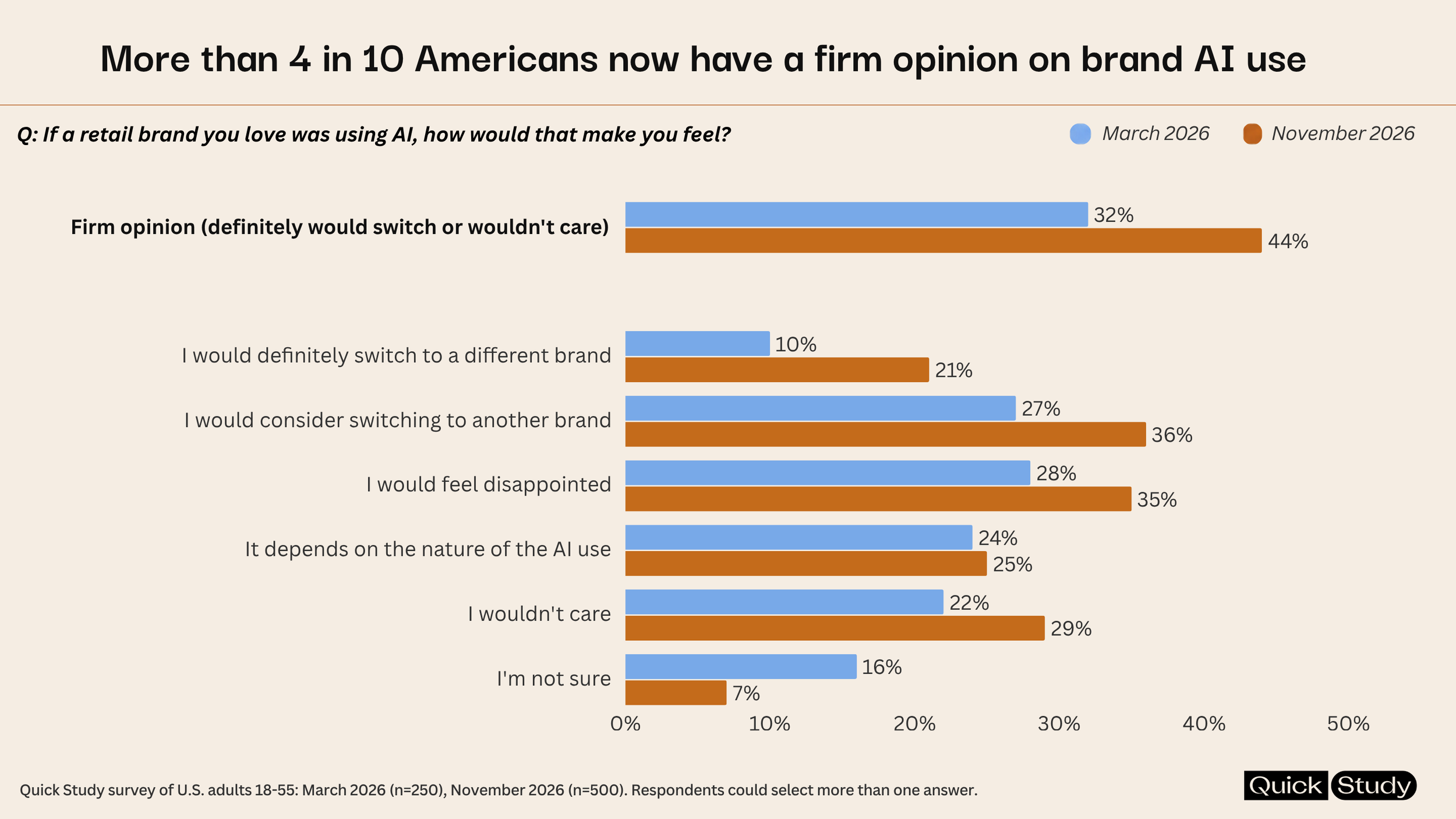
What’s left in the middle isn’t indecision; it’s conditional acceptance. A quarter (25%) of Americans say their reaction depends on how the brand uses AI. That leaves room for brands to make their case, but to an audience that’s paying attention and making judgments.
Behind-the-scenes use of AI by brands is no longer safe from consumer resistance.
The consumers we surveyed in March drew a red line at a brand’s AI use when it visibly replaced humans, such as customer service or product design. Other functions, like using AI to make internal operations more efficient or help with organizational strategy, were less concerning. That red line has moved.
Compared to March, consumers now object to far more uses of AI, including many they never see. The biggest increases in uses of AI that would make a consumer less likely to buy are all from the other side of March’s red line:
34% say they’re less likely to buy a brand if it uses AI for organizational strategy and leadership (+11)
27% say they’re less likely to buy a brand if it uses AI to increase the efficiency of internal operations (+10)
27% say they are less likely to buy a brand if it uses AI for general research and development projects (+12)
Visible uses of AI still matter, too. Nearly 4 in 10 (39%) say AI-generated content in advertising makes them less likely to buy, and customer service with no immediate human involvement (44%) is now the number one reason a consumer is less likely to buy from a brand because of how it uses AI. GWI’s tracking data from Q3 2026 found that only 6% of Americans prefer interacting with AI in customer service, a number that has barely moved for the last year.
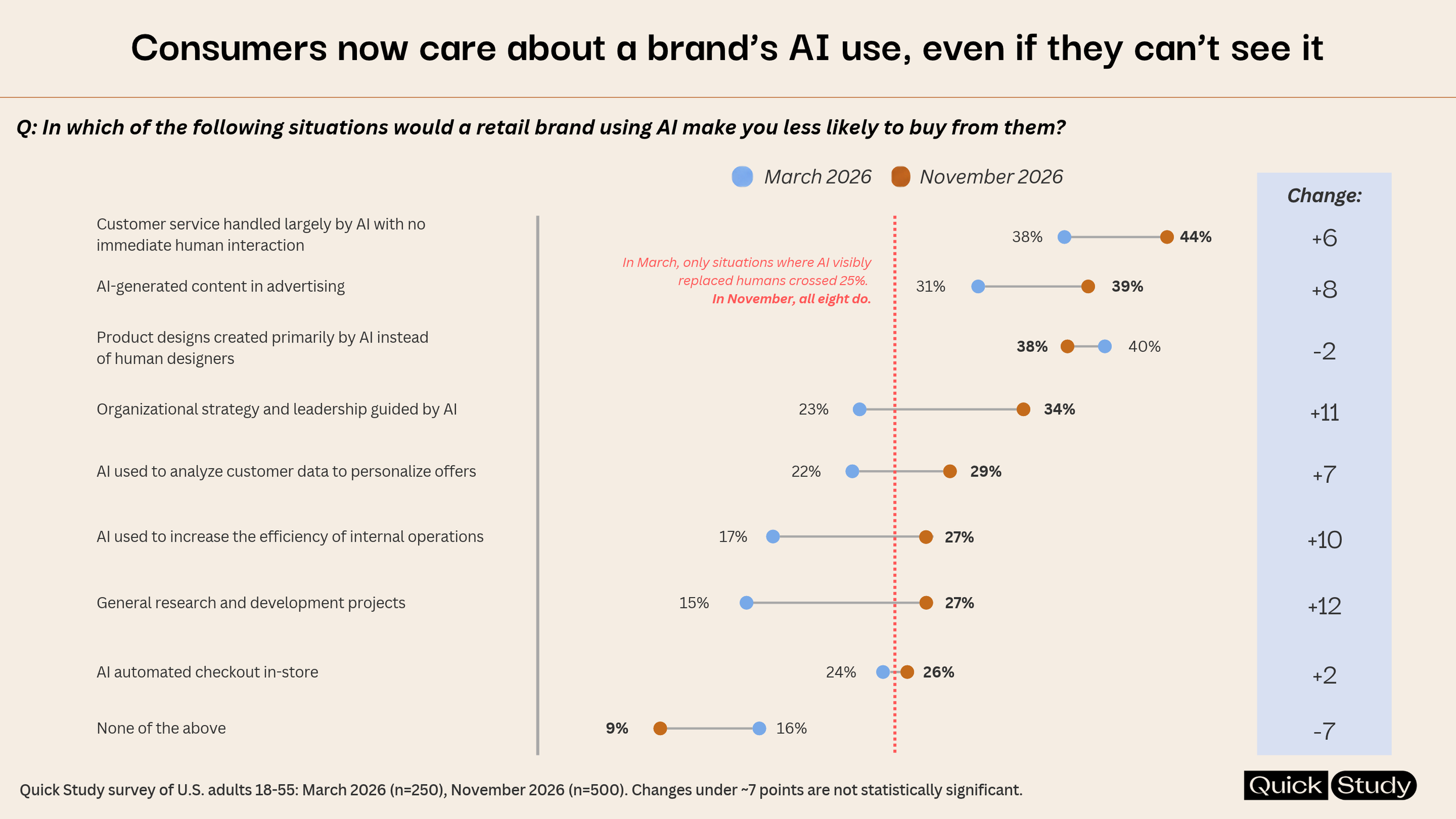
Consumers are judging both the AI they can see and the way brands use it behind the scenes.
Consumers increasingly expect a brand’s AI use to translate to lower prices.
In one of the biggest shifts in our survey, almost half (47%) of Americans now expect products from brands that use AI to cost less, up from 29% in March. As AI-driven layoffs add up and the possibility of efficiency gains grows, more consumers expect to share in the savings. “If they [are] replacing major portions of the labor in their companies, it should be cheaper,” one respondent told us.
This expectation rose across nearly every group surveyed. Among AI optimists, the expectation of lower prices nearly tripled from 20% to 56%. The expectation of lower prices also rose across incomes: households earning under $100k went from 29% to 41%, and those earning $100k+ went from 29% to 56%. Meanwhile, only 22% of all respondents expect products from brands that use AI to cost more, about the same as it was in March.
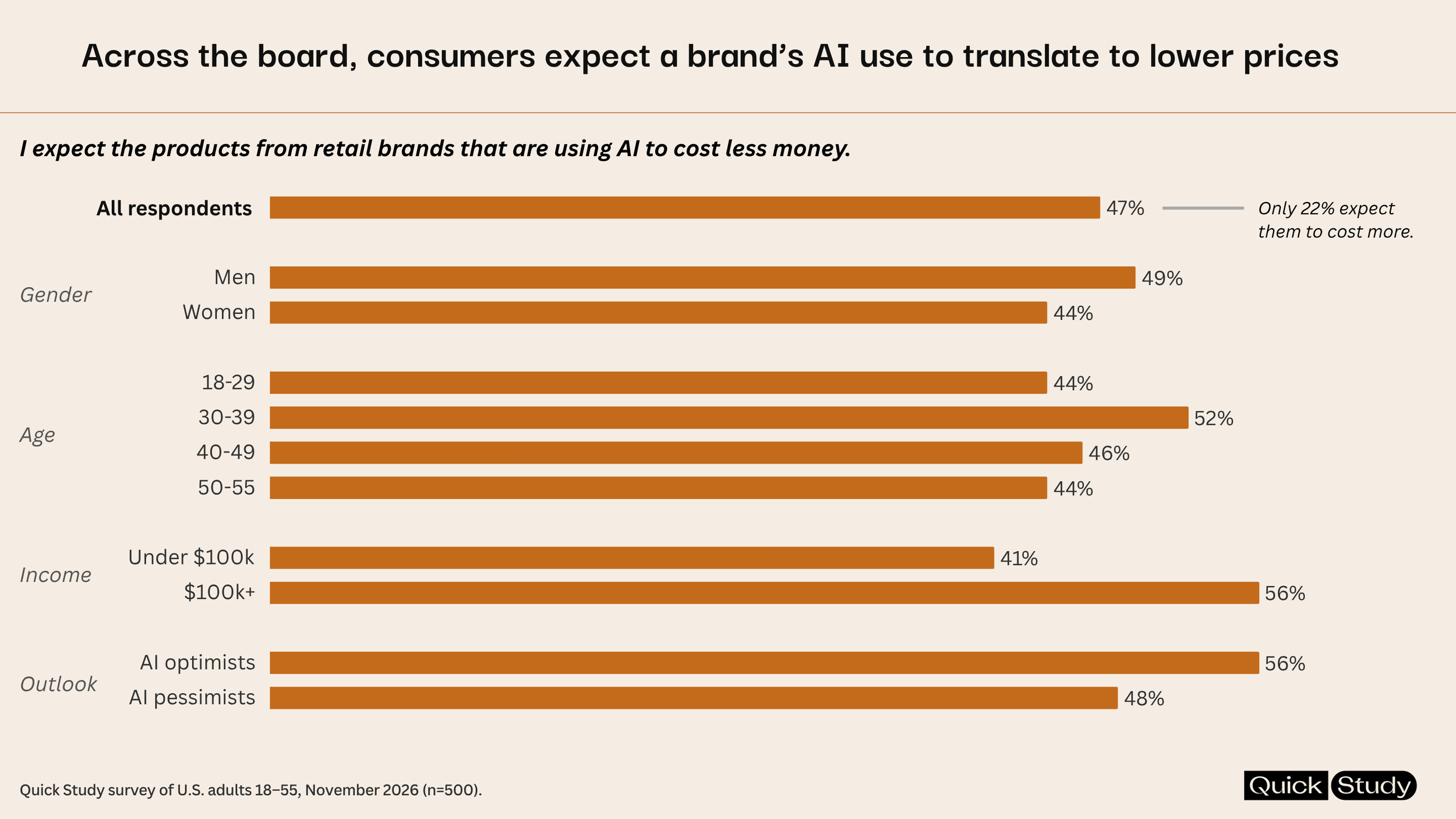
This isn’t a mandate to cut prices; it’s a reality check. Consumers now see AI as a source of savings, not added value. Brands need to show how AI makes things better for customers, not just cheaper for themselves.
A majority of Americans now expect brands to disclose AI use in advertising.
In March, 43% believed that brands should have to disclose the use of AI in advertising. Today it’s 60%. The growing backlash to AI “slop” on social media, and comment sections full of accusations of AI use are likely feeding it. “AI generated content, products/designs, and advertising would turn me away,” said one respondent.
With consumers watching more closely, getting caught carries real risk: “They are dead to me the moment I catch wind [of their AI use],” said one respondent. “If [AI is] used to replace art… or if it’s used to display how a product such as makeup looks on an AI-generated human, then I would switch [brands],” said another.
GWI’s November data echoes this: 71% of Americans want AI in ads labeled in some way, even if only in fine print, and another 22% say brands should avoid it entirely. But a label isn’t a free pass: 41% say a “Made with AI” label would make them less likely to buy.
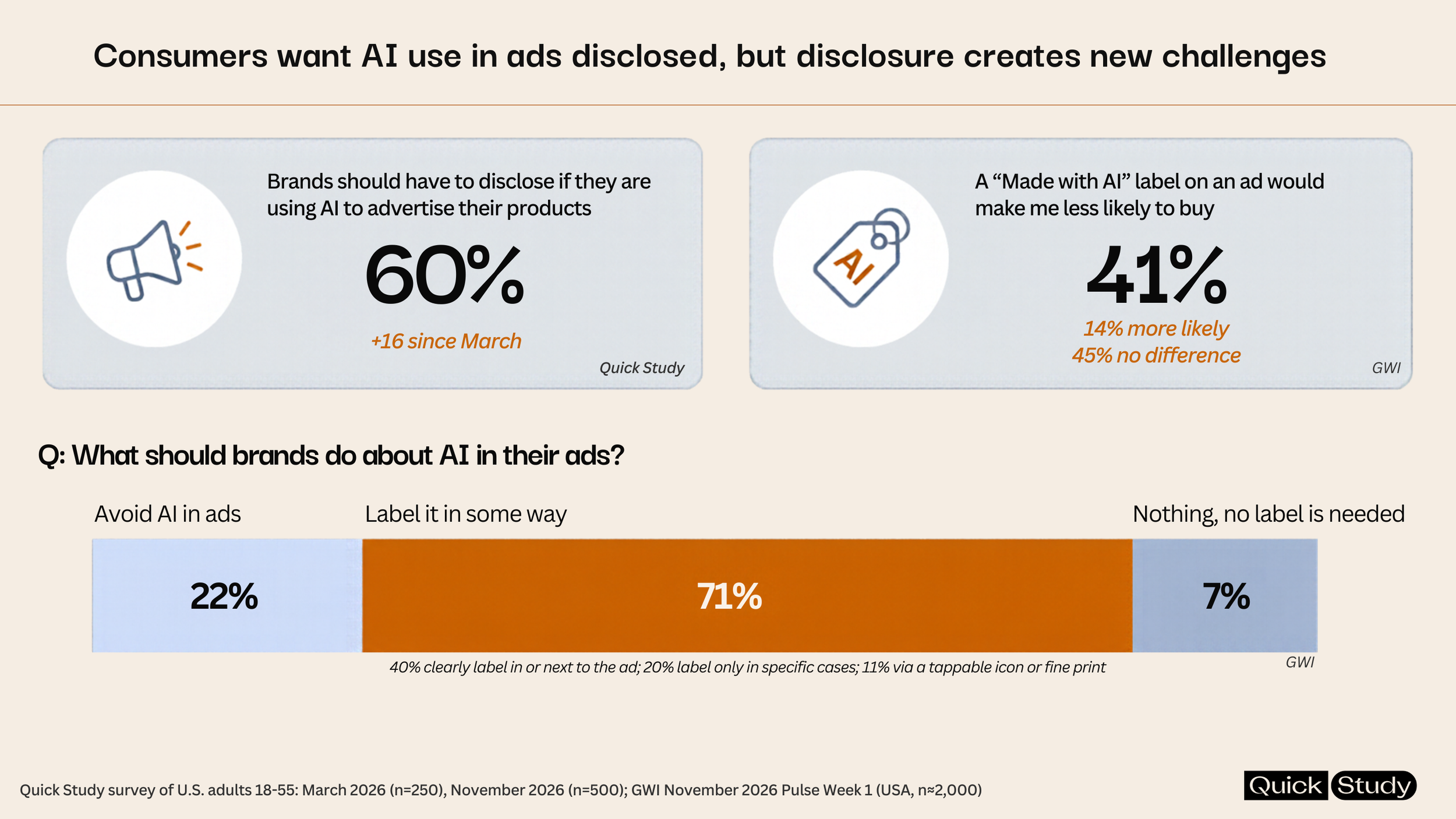
Disclosure is now the expectation. The harder work is making AI use something your brand can stand behind once it’s disclosed.
The terms have changed.
In eight months, consumers have gone from forming opinions about brand AI use to acting on them. They are more optimistic about a future with AI but less forgiving of the brands that use it, including uses they never see. They want to see savings. And they expect disclosure.
This holiday season, many brands are leaning into effort signaling, putting the human elements of their ad campaigns front and center. Our data suggests that these efforts will not be enough on their own. Consumers are now judging how brands use AI across the entire company, from R&D to internal operations to customer service. A stop-motion holiday commercial is nice, but it doesn’t change who (or what) will be responding to the customer service chat when someone tries to return a gift in January.
In March, we said AI was becoming a test of brand values. Eight months later, consumers are grading it. How will your brand score?
Global CEOs say Quick Study “moves at light speed without compromising on research and quality” and that we are “the real deal—the kind of team you want in your corner for all the big, gnarly, complex ‘how are we ever going to solve this?’ problems.” If your brand needs some smart problem solving, commission Quick Study to make a Study Guide for you.
Send us an email & we’ll custom design a plan that gets you the answers you need: hello@quick.study